
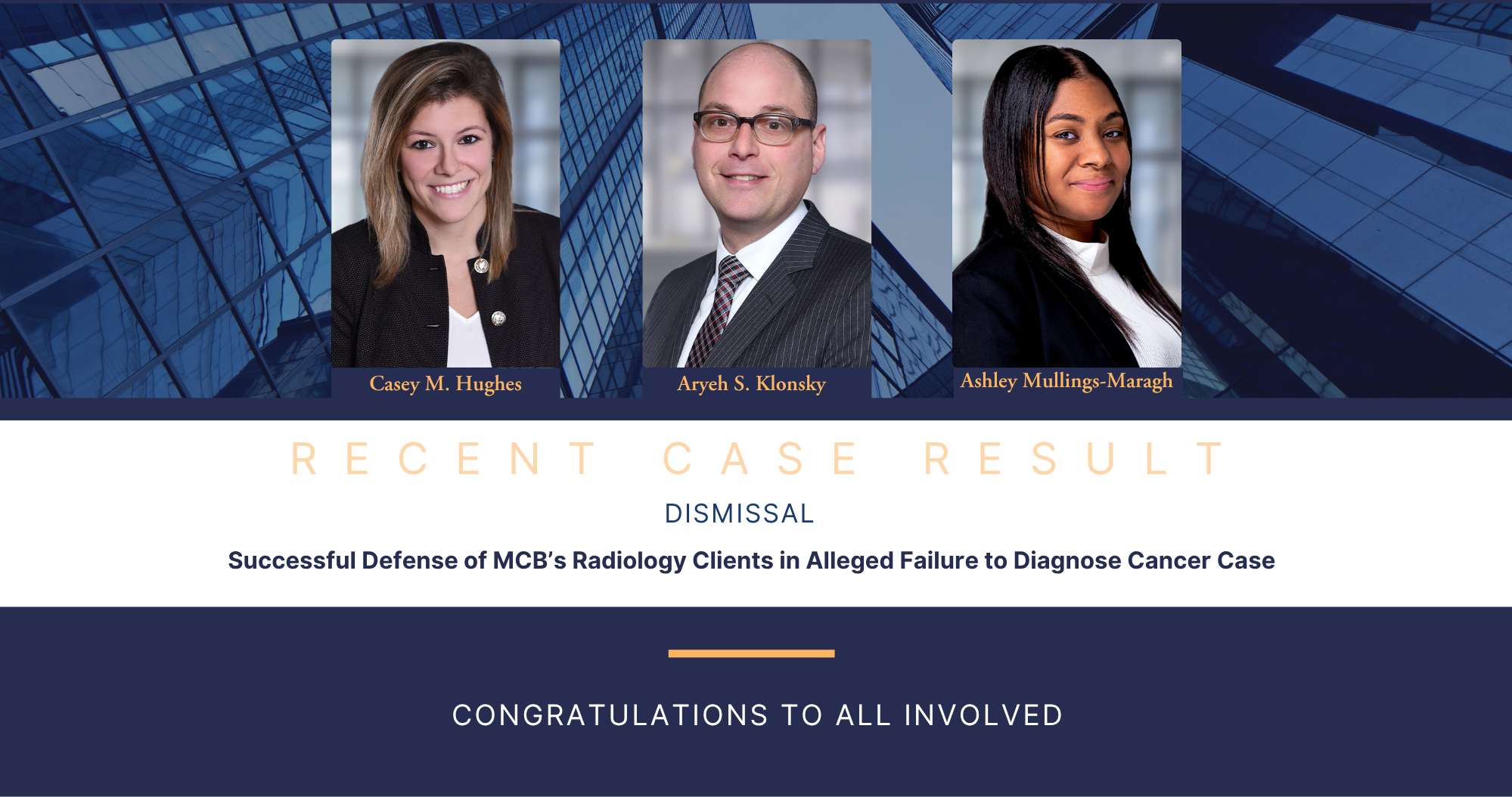
Senior Trial Partner Aryeh Klonsky, Partner Casey Hughes and Associate Ashley Mullings-Maragh successfully obtained dismissal of all claims in a potentially high exposure case pending in New York Supreme Court, Kings County, in a matter involving a failure to diagnose throat cancer in the then 59-year-old plaintiff who later developed advanced stage metastatic cancer requiring chemotherapy and radiation.
Plaintiff presented to an ENT with complaints of left sided throat pain for three (3) months, hoarseness, and a mass in the throat. The ENT ordered a CT of the neck with and without contrast performed at MCB’s client, an out-patient radiology facility. MCB’s radiologist-client interpreted the CT as negative. Following the completion of the CT, plaintiff’s ENT performed a tonsillectomy on the left tonsil. MCB’s radiologist-client subsequently prepared an addendum, documenting there was mild asymmetric enlargement of the left palatine tonsil concerning neoplastic etiology with recommendation for tissue sampling. Pathology from the ENT’s tonsillectomy was reportedly negative for cancer. Regarding the above, plaintiffs alleged that the radiologist failed to accurately interpret the CT images and failed to timely report the complete CT findings.
Plaintiff remained symptomatic and underwent a repeat neck CT six months later. MCB’s radiologist-client interpreted the study and identified post-surgical changes without recurrent mass. Plaintiffs alleged that the radiologist failed to accurately interpret the CT images and failed to report findings suspicious for cancer. Three years later, plaintiff was diagnosed with advanced stage hypopharynx cancer and was referred to a head and neck surgeon. The plaintiff underwent chemotherapy followed by radiation therapy.
MCB moved for Summary Judgment on behalf of its radiologist client and the outpatient radiology facility that performed the studies and employed the radiologist. We argued that the plaintiff’s hypopharynx cancer was unrelated to prior tonsillar findings on CT, and any alleged failure to properly and timely interpret the studies was not the proximate cause of the plaintiff’s alleged injuries. Due to the strength of our arguments set forth in our motion papers, raising both standard of care defenses and causation defenses, plaintiffs’ counsel advised they were unable and unwilling to oppose our motion. Plaintiffs voluntarily discontinued the case in its entirety.